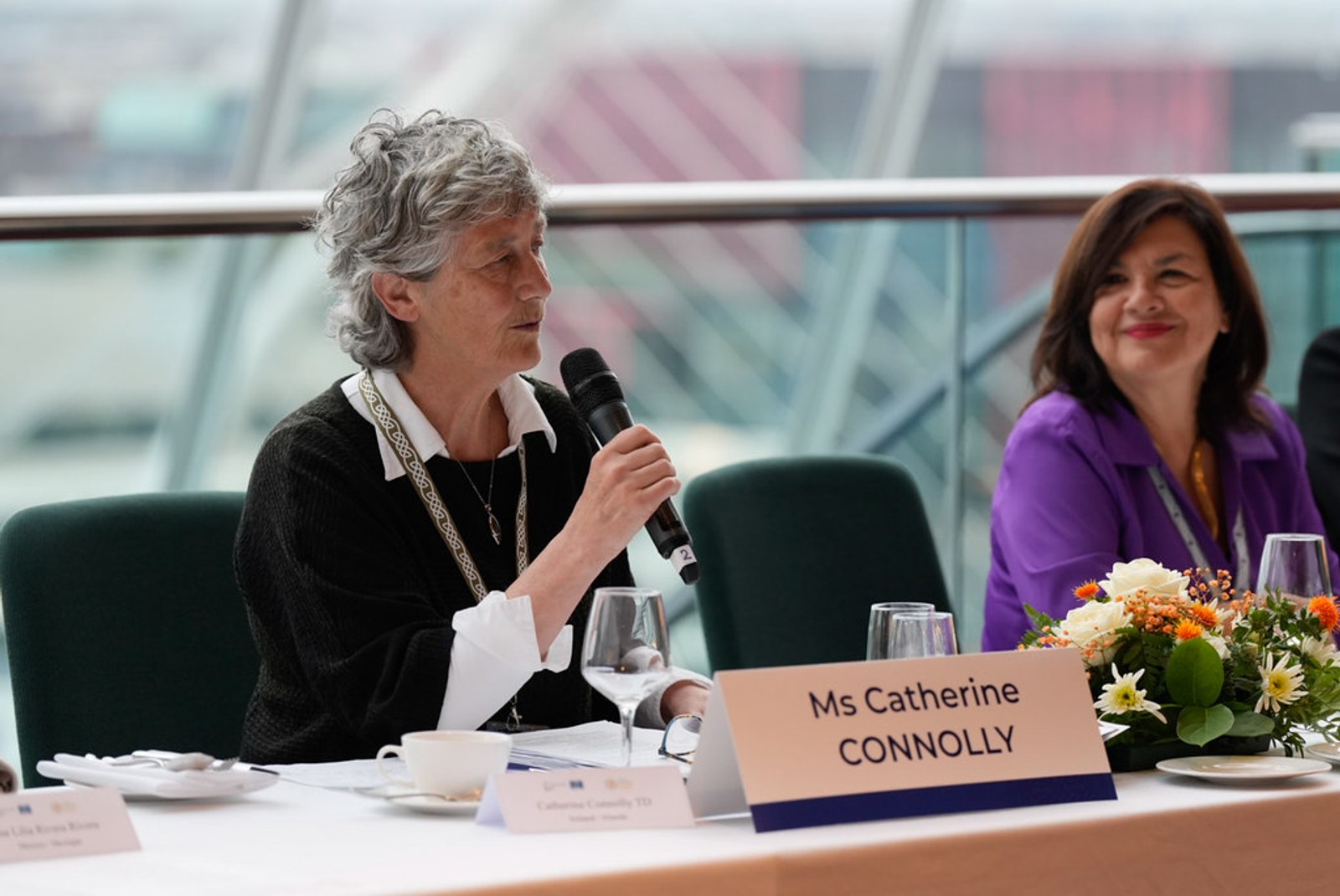
President Catherine Connolly has thrown a green grenade into the already fraught landscape of Irish-American relations. Her St. Patrick's Day message, a traditionally saccharine affair of shamrocks and sentimentality, detonated with a stark warning against the "normalisation of war" and a blistering critique of "violations of international law" in the Middle East. The timing, as impeccable as it is incendiary, lands just days before Taoiseach Micheál Martin is scheduled to genuflect before Donald Trump in the Oval Office. The question now hangs heavy in the Dublin air: will Martin uphold Ireland's cherished neutrality, or will he, like so many before him, bend the knee to American power?
will Martin uphold Ireland's cherished neutrality, or will he, like so many before him, bend the knee to American power?
Connolly's words, carefully chosen yet undeniably provocative, paint a grim picture of a world sleepwalking into perpetual conflict. Describing the war in the Middle East as a "deliberate assault on international law," she didn't mince words, nor did she shy away from the uncomfortable truth that Ireland's allies, particularly the United States, bear a significant responsibility for the chaos. The "horror of war" in the region, she said, was "shocking and numbing." Her message, delivered on a day meant for celebration, served as a jarring reminder of the global realities often obscured by green beer and blarney.
The President's intervention, her first St. Patrick's Day message since taking office, immediately sparked a firestorm. Government officials scrambled to respond, attempting to downplay the significance of her remarks while simultaneously reaffirming Ireland's commitment to peace and international law. The media, predictably, seized upon the controversy, with RTÉ News, among others, highlighting the contentious nature of her comments on social media. The predictable cries of "unprecedented!" and "diplomatic faux pas!" filled the airwaves, conveniently ignoring the long and storied tradition of Irish dissent against imperial powers.
But Connolly's broadside is more than just a symbolic gesture of defiance. It represents a fundamental challenge to the cosy, often unquestioning, relationship between Ireland and the United States. For decades, Irish politicians have trod a delicate line, balancing the economic benefits of American investment with the moral imperative to stand against American militarism. This balancing act, however, has often involved a degree of self-censorship, a reluctance to publicly criticise US foreign policy for fear of jeopardising trade deals and political alliances. Connolly, it seems, is having none of it.
And why should she? Ireland, a nation forged in the crucible of resistance against colonial oppression, has a moral obligation to speak out against injustice wherever it occurs. We, of all people, should understand the devastating consequences of unchecked power and the importance of upholding international law. To remain silent in the face of American aggression, to normalise the "normalisation of war," would be a betrayal of our own history and our own values.
The Taoiseach's upcoming meeting with Trump presents a crucial test. Will Martin use the opportunity to raise Ireland's concerns about US foreign policy, to challenge the "deliberate assault on international law" that Connolly so eloquently condemned? Or will he offer only platitudes and photo ops, sacrificing principle for political expediency?
We know Trump's record. He's a man who tears up international agreements like confetti, who cozies up to dictators, who sanctions countries into oblivion, and who seems to revel in the chaos he creates. He's a man who sees the world as a chessboard, and human lives as mere pawns. To sit down with him, to shake his hand, is to implicitly endorse his actions, to legitimise his brand of reckless, unilateralist foreign policy.
Some will argue that Martin has no choice, that Ireland's economic dependence on the United States necessitates a degree of deference. They will claim that criticising Trump would be bad for business, that it would jeopardise Irish jobs and investment. But this is a false choice. We can maintain a healthy economic relationship with the United States without abandoning our moral compass. We can stand up for what is right without sacrificing our prosperity. In fact, by doing so, we may even earn the respect of the American people, many of whom are themselves deeply troubled by their government's actions.
The truth is, kowtowing to Trump is not only morally repugnant, it's also politically short-sighted. Trump's presidency is an aberration, a temporary blip in the long arc of American history. He will not be in power forever. When he is gone, Ireland will still have to live with the consequences of its decisions. Do we want to be remembered as a nation that stood up for principle, or as a nation that cowered in fear?
President Connolly has shown us the way. She has demonstrated that it is possible to speak truth to power, even when that power resides in the Oval Office. She has reminded us that Ireland has a voice on the world stage, and that we have a responsibility to use it.
Now it is up to the Taoiseach to follow her lead. He must enter that meeting with Trump armed with more than just shamrocks and smiles. He must bring with him the courage to speak truth, the conviction to stand for justice, and the unwavering commitment to upholding international law. He must show the world that Ireland is not just a land of leprechauns and Guinness, but a nation of principled people who refuse to normalise war and who will always stand on the side of peace. The ghosts of 1916 demand no less.

Founder and Editor in Chief of The Irish Bugle.